Earthquake relocation enables a much more precise insight on the earthquake hypocenter distribution. The first direct application is the study of the active faults? geometry and in a second step, with other techniques, the study of the fault-earthquake relationship.
Two hypothesis underlie the relocation. For two closely located earthquakes, assuming they occurred at exactly the same origin time, it is considered that the difference in the wave travel times is due to the different location. This is true only if it can be presumed that the waves follow the same path, which is the case if the distance to the station is much greater than the distance between the two events. The second hypothesis states that two waveforms which have great resemblance are considered to be produced by two nearby earthquakes with similar fault mechanisms.
The
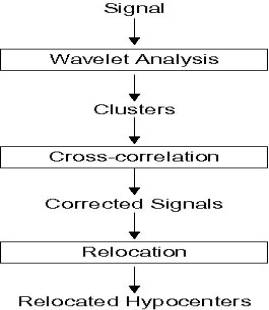
relocation procedure involves three major steps: (Figure 1)
i. identification of clusters of earthquakes
ii. cross-correlation of the signals within each cluster for each station
iii. relocation of the events
Figure
1. The
three major steps for the relocation procedure as used in this study.
In the procedure that is being developed, to isolate the clusters, we use a technique based on wavelet transform. (Zhizhin et al., 1992) For all signals, the transform is computed and compared to all other. The resulting matrix is then analysed and clusters are identified. (Figure 2 and 3)
The next step consists of calculating, for all the signals from all the available seismic stations of one cluster, the time delays of the P- and the S-wave arrivals to ensure that all arrivals are picked on the same phase. This is obtained by cross-correlating all the signals of one cluster with each other, respecting the stations and components of each seismic record. The technique used here is based on spectral cross-correlation. (Got et al., 1994 ) (Figure 4)
Finally
the earthquakes, with corrected P- and S-wave arrival times, are relocated.
This can be done with various methods. We use a master-slave method (Gaucher,
1998), and a double-difference algorithm for absolute and relative arrival
times: HYPODD. (Waldhauser and Ellsworth, 2000) An example of relocation
results using a master to slave method is presented in figure 5.
Figure
2. The
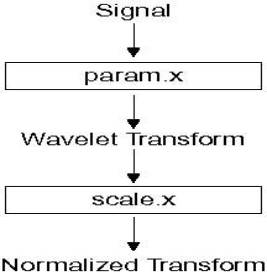
signal (SAC file) in "param.x" is cut 0.5 seconds before the first arrival
and is set to last 4.096 seconds. The wavelet transform of this reduced
record is computed and the resulting spectral energy in function of time
representation of the seimic event is obtained. The transform is normalized
to 60 decibels in "scale.x".
Figure
3. All
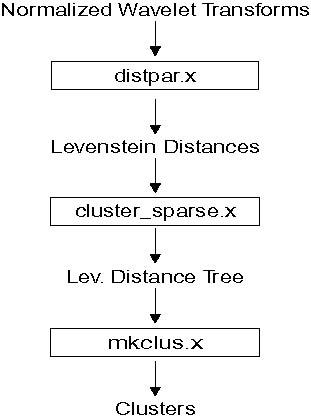
the normalised wavelet transforms are compared in the program "distpar.x"
and the Levenstein dissimilarity distance is calculated for all pair of
events. "Cluster_sparse.x" organises the events in function of their dissimilarity
and produces a tree-type representation, in which, at the primary level,
the closest two events are linked (smallest Levenstein distance). At the
secondary level the next closest event (next smallest Levenstein dist.),
pair or group of events is linked. This scheme is repeated until all events
are placed. Clusters of events are identified as groups of events which
are separated by small Levenstein distances. So by reading the tree, clusters
of events are isolated. This is achieved automatically with "mkclus.x".
Figure
4. The
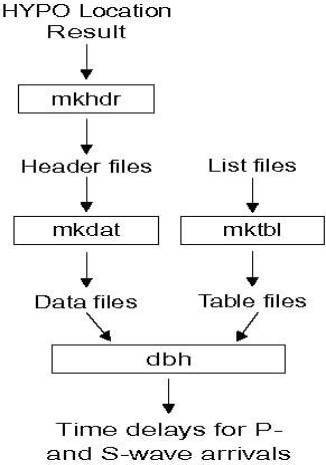
results of the HYPO inversion program, namely the origin time of the earthquake,
the location and the arrival time of the P-wave at each station, for each
event are written in a "header file". The "header files" is then read by
"mkdat" which basically rewrites the SAC file for each processed event
into the input format, "data file", for the cross-correlation program "dbh".
Simultaneously, all processed events need to be listed, according to the
cluster to which they belong, in a "list file". The format of the "list
files" are transformed by "mktbl". Both, the "data files" and "table files"
are input to "dbh". This last program, with a spectral cross-correlation
technique, computes the time delays of the P- and S-wave arrival times
between all possible pairs of events at each station.
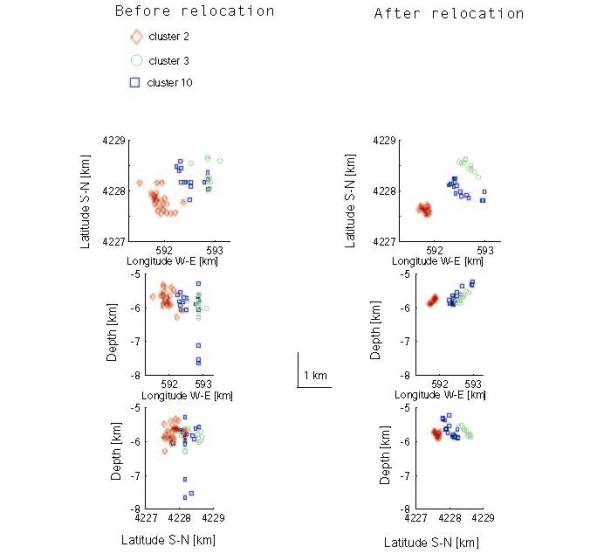
Figure
5. Relocation
results of the master-slave method for three clusters located under the
southern coast of the Corinth Rift, south of the city of Aigion. The
events in the individual clusters are relocated relative to a master event.
The master event has therefore to be carefully chosen so as to be a well
recorded event with clear first arrivals at the greatest number of stations.
Bibliography
GAUCHER
E., 1998. Comportement hydromécanique d'un massif fracturé
: apport de la microsismicité induite, Thèse de doctorat
de l'université Paris VII.
GOT
J.L., FRECHET J. and KLEIN F., 1994. Deep fault plane geometry inferred
from multiplet relative relocation beneath the south flank of Kilauea,
J. Geophys. Res., 99, pp 15375-15386.
WALDHAUSER
F. and ELLSWORTH W.L., 2000. A double-difference earthquake location algorithm:
Method and application to the northern Hayward Fault, California, Bull. Seismol.
Soc. Am., 90, pp 1353-1368.
ZHIZHIN
M., et al., 1992. Classification of strong motion waveforms from different
geological regions using syntactic pattern recognition scheme, Cahiers
du Centre Européen de Géodynamique et de Sismologie, 6, pp
33-42.